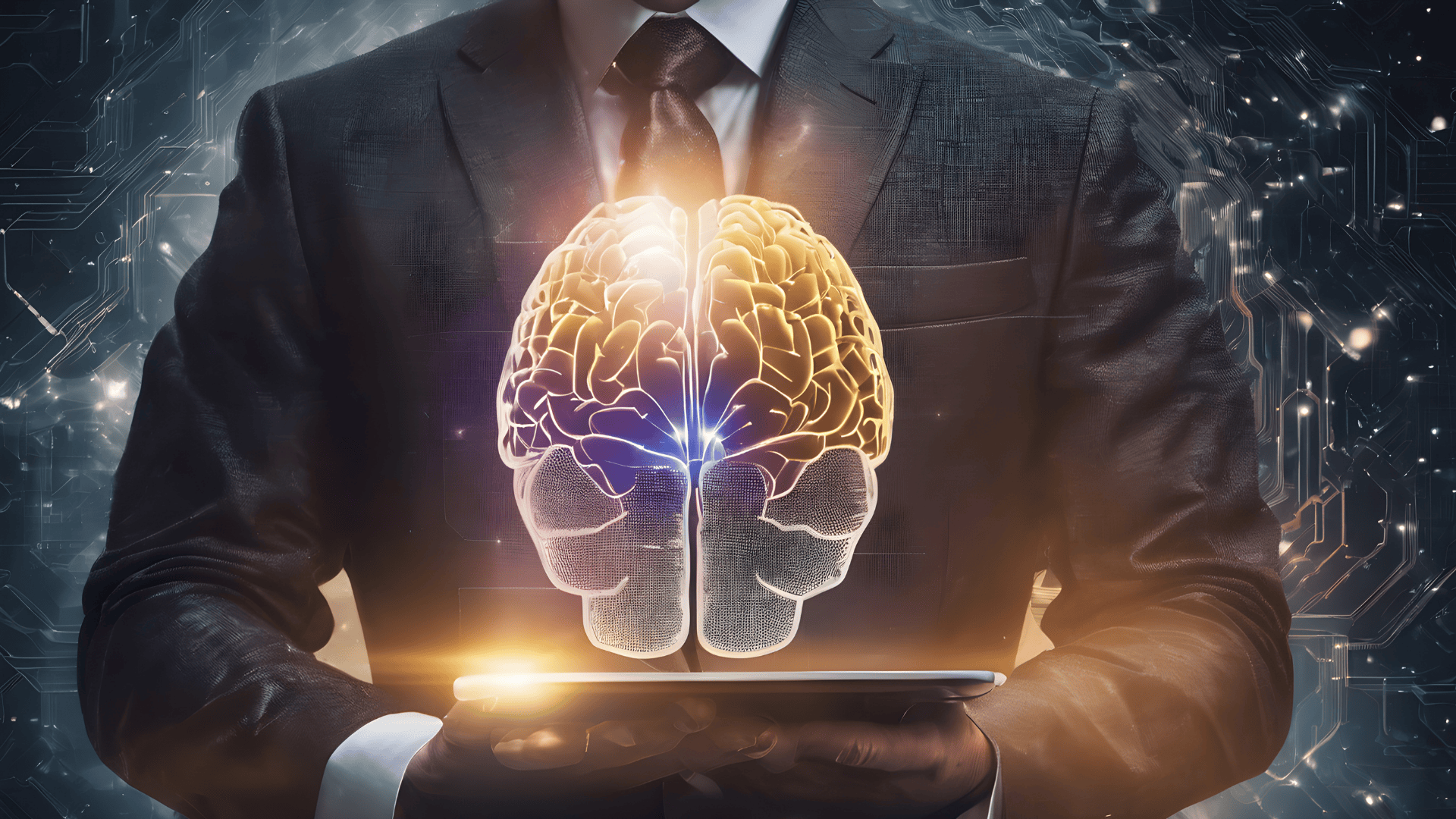
The Brain Chemistry Behind Why Your Best Ideas Never Come From AI
You've felt it before-that moment when a solution arrives unbidden during your morning shower, or when a strategic insight crystallizes while you're walking between meetings. These aren't random accidents of thought. They're the signature of a biological process that no algorithm can replicate, and understanding why might be the most important competitive advantage you'll develop as a leader in the age of artificial intelligence.
Right now, as you read these words, your brain is doing something extraordinary. It's weaving together memories from your career history, emotions from recent conversations, sensory impressions from your environment, and abstract patterns you've accumulated over decades of experience. This integration isn't happening in neat, linear sequences. It's occurring across multiple neural networks simultaneously, with each connection influenced by chemical messengers that respond to your current emotional state, your sleep quality from last night, and even your gut microbiome. This chaotic, embodied complexity is precisely what makes human thinking irreplaceable-and it's exactly what artificial intelligence can never achieve.
The distinction matters now more than ever. As AI tools become increasingly sophisticated at pattern recognition and data analysis, corporate leaders face mounting pressure to defer to algorithmic recommendations. The temptation is understandable. AI offers speed, consistency, and the appearance of objectivity. But every time you outsource a decision to an algorithm, you're bypassing the very cognitive processes that generate transformational thinking. You're trading breakthrough potential for optimization efficiency. And in competitive markets, that trade-off can be fatal.
The Architecture of Insight: How Your Brain Actually Creates New Ideas
When neuroscientists study creative breakthrough moments-those instances when someone solves a problem in an entirely novel way-they observe a distinctive pattern of brain activity that looks nothing like linear processing. The prefrontal cortex, which governs focused analytical thinking, actually shows decreased activation. Meanwhile, the default mode network, a collection of brain regions that activate during rest and mind-wandering, becomes highly engaged. This isn't cognitive laziness. It's the brain entering a state where it can forge connections between disparate domains of knowledge that would never be linked through logical analysis alone.
This process depends fundamentally on something AI cannot possess: embodied experience. Your brain doesn't store information the way a database does, as discrete packets of retrievable data. Instead, every concept you understand is encoded within networks of neurons that also carry emotional valence, sensory associations, and contextual memories. When you think about “market disruption,” you're not accessing a definition-you're activating a rich constellation of experiences that includes the anxiety you felt during your company's last pivot, the texture of the conference room where you debated strategy, and the pattern recognition you've developed from witnessing dozens of competitive shifts throughout your career.
These emotional and sensory dimensions aren't extraneous noise cluttering up pure logic. They're the substrate that enables genuine creativity. When your brain makes an unexpected connection between seemingly unrelated concepts-say, recognizing that a problem in supply chain management might be solved using principles from ecological systems-it's drawing on these embodied associations. The “aha moment” arrives when neural networks that typically operate independently suddenly synchronize, creating a bridge between domains that rational analysis would never connect. This synchronization is mediated by neurotransmitters responding to your emotional state, your level of psychological safety, and your openness to uncertainty. It's a deeply biological process that requires a body, not just an information processor.
Why Pattern Disruption Requires Emotional Capacity
Artificial intelligence excels at pattern recognition precisely because it's designed to identify consistent structures in data and optimize within existing frameworks. This capability makes AI extraordinarily valuable for certain tasks. But breakthrough innovation, by definition, requires breaking patterns-seeing possibilities that don't exist in historical data, imagining futures that haven't been modeled, and taking risks that no probability calculation would recommend.
Your capacity for this pattern disruption is rooted in emotional systems that evolved to help humans navigate uncertainty. When you encounter a problem that doesn't fit existing solutions, your brain doesn't simply process that as an error in the data. You experience it as discomfort, frustration, or curiosity-emotional states that trigger specific neurochemical cascades. These chemical changes alter how your neural networks communicate, temporarily loosening the grip of habitual thought patterns and increasing the probability that your brain will explore novel conceptual territory.
Consider what happens in your mind when you're genuinely grappling with a strategic challenge that has no clear answer. There's discomfort in that uncertainty. Your amygdala registers the ambiguity as a form of threat, triggering arousal in your sympathetic nervous system. But if you have sufficient psychological resources-enough safety, confidence, and cognitive flexibility-you can tolerate that discomfort without collapsing into premature closure. You can sit with the not-knowing. And it's precisely in that state of sustained uncertainty that your brain begins making unusual connections, testing improbable hypotheses, and generating ideas that transcend optimization of the known.
AI has no mechanism for this kind of productive discomfort. An algorithm doesn't experience the tension of cognitive dissonance or the drive to resolve conceptual contradictions. It processes inputs according to its training parameters, generating outputs that represent sophisticated combinations of patterns it has already encountered. This means AI can help you optimize within existing paradigms, but it cannot lead you toward paradigm shifts. It cannot feel its way toward breakthrough because it cannot feel at all.
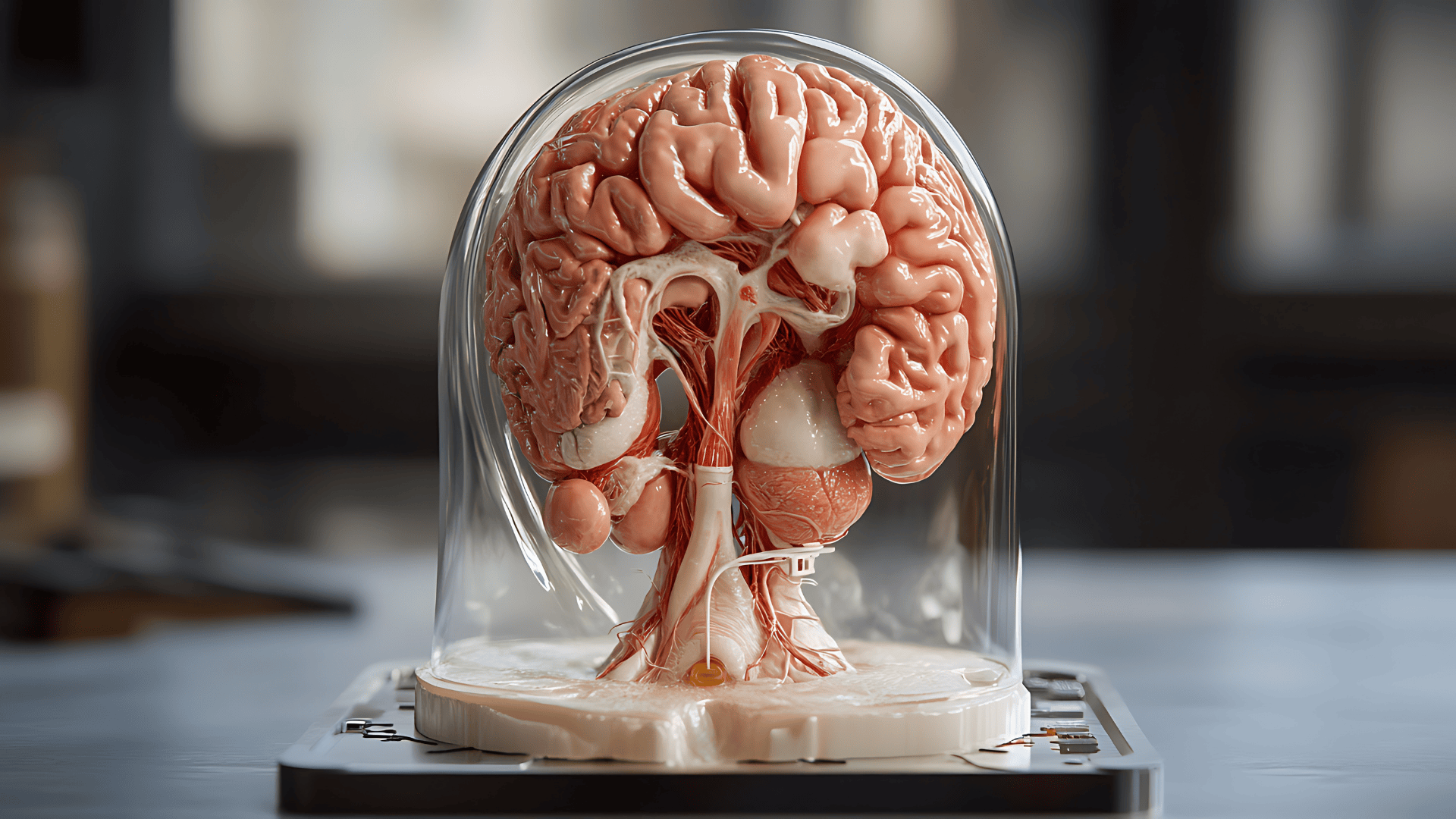
The Chemistry of Courage: Neurobiological Foundations of Risk-Taking
Every transformational decision you've made as a leader involved a moment when you had to act despite incomplete information, uncertain outcomes, and the very real possibility of failure. These moments activate specific neurochemical systems that influence not just how you feel about risk, but how your brain processes potential futures and evaluates trade-offs between safety and opportunity.
Dopamine plays a central role in this calculation, but not in the simplistic way popular psychology often suggests. Your dopaminergic system doesn't simply “reward” success. It's actually tuned to detect deviations from expectations-both positive surprises and disappointing outcomes-and it uses those signals to update your internal models of how the world works. When you make a courageous strategic choice and it succeeds beyond prediction, the burst of dopamine doesn't just feel good. It reinforces the neural pathways that led to that decision, increasing the probability that you'll recognize similar opportunities in the future and have the confidence to pursue them.
This learning system depends crucially on skin in the game. Your brain weighs decisions differently when you have personal stakes-when your reputation, resources, or emotional well-being are on the line. The neurological reality is that you cannot develop sound judgment about transformational risk by analyzing datasets. You develop it through embodied experience of consequence. Each time you make a decision under uncertainty and live with the results, your brain is calibrating its reward prediction systems, refining its models of risk and opportunity, and building the neural infrastructure for intuitive wisdom.
AI can calculate probabilities based on historical data, but it cannot develop wisdom because it has no self to stake, no reputation to risk, and no emotional system that experiences consequence viscerally. This isn't a limitation that better algorithms will overcome. It's a fundamental difference between simulation and lived experience. Your capacity to make courageous decisions isn't about having superior data analysis-it's about having developed, through years of embodied learning, the neurobiological infrastructure to act decisively in the face of irreducible uncertainty.
Self-Awareness as Neural Architecture
The most sophisticated AI systems currently deployed in corporate settings lack something that every human leader possesses: metacognition. You can think about your own thinking. You can notice when you're falling into cognitive biases, recognize when emotions are coloring your judgment, and deliberately shift your mental state to access different cognitive resources. This capacity for self-reflection isn't just useful-it's the foundation of adaptive intelligence in complex environments.
When you develop self-awareness as a leader, you're literally changing the architecture of your brain. Practices that cultivate metacognition-whether through reflective journaling, meditation, coaching conversations, or structured decision reviews-strengthen connections between your prefrontal cortex and deeper emotional centers like the amygdala and insula. These stronger connections allow you to perceive your emotional reactions in real time without being overwhelmed by them, creating space for more flexible responses to challenging situations.
This neural integration is what enables emotional intelligence, and emotional intelligence is what separates leaders who adapt successfully to unprecedented challenges from those who rigidly apply past solutions to new problems. When you can recognize that your resistance to a team member's idea stems from your own ego protection rather than objective evaluation, you create the possibility for better decisions. When you can feel the anxiety of uncertainty without immediately grasping for false certainty, you preserve access to creative problem-solving. These capacities emerge from brain systems that continuously monitor and modulate your internal states-systems that AI does not and cannot possess.
The Transformation Versus Optimization Distinction
Understanding the difference between what AI does brilliantly and what human minds alone can achieve requires clarity about the distinction between optimization and transformation. Optimization means making existing systems more efficient-identifying the best route through known territory, finding inefficiencies in current processes, or predicting outcomes based on historical patterns. AI excels at optimization because it can process vast amounts of data far faster than human cognition, identifying patterns and correlations that would take years of human analysis to detect.
Transformation, by contrast, means fundamentally reimagining the territory itself. It's not about finding the best path through existing landscape-it's about recognizing that you need to be on different terrain entirely. This requires the capacity to envision possibilities that don't exist in the data, to imagine futures that break from past patterns, and to integrate insights across domains in ways that generate genuinely novel approaches.
Picture this scenario: imagine you're leading a company facing market disruption from an unexpected competitor. AI can analyze that competitor's strategy, identify their operational patterns, predict their next moves based on their historical behavior, and recommend tactical responses that optimize your position within the existing competitive framework. All of that is valuable. But AI cannot do what you can do as a human leader-step back from the entire frame and ask whether you're in the right business at all. It cannot feel the intuitive recognition that the market itself is fundamentally shifting, requiring not tactical adjustment but strategic reinvention.
This transformational thinking emerges from your capacity to hold multiple frames of reference simultaneously, to feel your way through ambiguity using embodied wisdom, and to imagine possibilities that have no precedent in historical data. These aren't mystical abilities-they're neurobiological capabilities rooted in the brain's capacity for abstract reasoning, emotional integration, and embodied simulation. You can literally feel your way into future scenarios, testing them against your accumulated experience and intuitive sense of rightness. AI generates predictions; you generate vision.
Cultivating the Conditions for Breakthrough Thinking
If breakthrough ideas emerge from specific neurological conditions that integrate emotion, embodied experience, and pattern disruption, then developing your capacity for transformational thinking isn't about working harder or thinking faster. It's about creating the conditions where your brain can do what it does naturally-make unexpected connections, integrate disparate information, and generate genuinely novel solutions.
This means intentionally building space for the kind of cognitive processing that produces breakthrough insights. Your brain doesn't generate its most innovative thinking during back-to-back meetings or while you're pushing through your task list in a state of stress-driven focus. It generates breakthrough ideas when you're in states that feel unproductive by conventional metrics-during walks where your mind wanders, in conversations where you're genuinely curious rather than advocating, in moments of rest where you're processing experiences rather than consuming new information.
The neuroscience here is clear: the default mode network that enables creative connection-making becomes active specifically when you're not engaged in focused, goal-directed activity. This doesn't mean insight arrives through passive waiting. It means that periods of intense focus need to be balanced with periods of open attention where your brain can integrate what you've been working on, connect it with broader patterns from your experience, and generate the unexpected associations that feel like creative breakthrough.
As a leader, this has profound implications for how you structure your time and energy. The pressure to maximize productivity by filling every moment with task completion actively undermines your capacity for the kind of thinking that creates competitive advantage. When you eliminate all white space from your calendar, when you train yourself to immediately reach for your phone during any moment of potential boredom, and when you treat reflective time as indulgent rather than essential, you're systematically dismantling the conditions your brain needs for transformational insight.
Emotional Intelligence as Innovation Infrastructure
The connection between emotional intelligence and innovative thinking isn't coincidental or tangential-it's mechanistic. Your capacity to recognize and work skillfully with emotions, both your own and others', directly influences the neural conditions that enable creative breakthrough. When you're in a state of psychological safety, when you can tolerate the discomfort of uncertainty, and when you maintain genuine curiosity about perspectives different from your own, your brain is quite literally in a different neurological state than when you're defensive, stressed, or rigidly attached to being right.
These different states are mediated by specific neurochemicals that influence how broadly or narrowly your attention operates, how flexibly you can shift between different conceptual frameworks, and how readily you can access memories and associations from different domains of your experience. High-stress states, for instance, trigger the release of cortisol and norepinephrine that narrow your focus and bias your cognition toward threat detection and habitual responses. This state has evolutionary value when you're facing immediate danger, but it actively inhibits the kind of open, exploratory thinking that generates innovation.
Conversely, states characterized by curiosity, safety, and moderate challenge trigger different neurochemical patterns that broaden attention, increase cognitive flexibility, and enhance your brain's capacity to form novel associations. Developing emotional intelligence means learning to recognize when you're in states that support creative thinking versus states that constrain it-and cultivating the self-regulation skills to shift your neural state intentionally.
This is why the most innovative leaders aren't necessarily the most analytically brilliant or the most technically expert. They're the ones who have developed the emotional capacity to create psychological safety for themselves and their teams, to navigate uncertainty without premature closure, and to maintain genuine curiosity even in the face of pressure for immediate answers. These emotional capacities aren't soft skills that complement hard analytical thinking-they're the neurological prerequisites for the kind of thinking that generates breakthrough innovation.

Your Irreplaceable Competitive Advantage
As artificial intelligence becomes more sophisticated and more integrated into business operations, the temptation will grow to treat human judgment as a legacy system-something to be minimized, systematized, or optimized away. This would be a catastrophic strategic error. The aspects of human cognition that feel most uncertain, most inefficient, most resistant to standardization are precisely the aspects that generate competitive advantage in complex, rapidly changing environments.
Your capacity for transformational thinking isn't a nice-to-have supplement to algorithmic analysis. It's the core capability that determines whether your organization adapts successfully to unprecedented challenges or becomes progressively more efficient at solving yesterday's problems. The neurobiological processes that enable breakthrough innovation-emotional integration, embodied wisdom, pattern disruption, courageous risk-taking in the face of uncertainty-these are not weaknesses to be overcome through better technology. They're distinctly human advantages to be cultivated, protected, and strategically deployed.
This means making deliberate choices about how you develop as a leader and how you structure your cognitive environment. It means recognizing that the time you spend in reflection, the walks where you let your mind wander, the conversations where you're genuinely curious rather than persuading-these aren't breaks from productive work. They're the work itself. They're the activities that create the neurological conditions for the kind of thinking that no algorithm can replicate.
It also means being skeptical of the creeping efficiency mindset that treats every moment as an opportunity for optimization. Your brain doesn't work that way. The neural processes that generate breakthrough thinking require what looks like inefficiency from the outside-time spent on problems with no clear solution, exploration of tangential ideas, integration of seemingly irrelevant experiences. When you eliminate these “inefficiencies” in the name of productivity, you're not becoming more effective. You're trading your capacity for transformation for slightly better optimization.
The leaders who will thrive in an AI-augmented world won't be those who most successfully outsource their thinking to algorithms. They'll be those who develop the wisdom to know which problems require human judgment and the discipline to create the conditions where that judgment can operate at its highest level. They'll be the ones who understand that their competitive advantage lies not in processing information faster than AI, but in bringing capacities to decision-making that AI fundamentally cannot possess-embodied wisdom, emotional intelligence, courageous vision, and the ability to imagine futures that don't exist in historical data.
The Science of Your Strategic Edge
The question facing you as a leader isn't whether to use AI-of course you should leverage these powerful tools for the tasks they excel at. The question is whether you'll recognize and protect your distinctly human cognitive advantages, or whether you'll gradually erode them by deferring to algorithmic thinking for decisions that require human wisdom.
The neuroscience makes clear that breakthrough innovation emerges from neural processes that integrate emotion, embodied experience, and the capacity to imagine possibilities beyond existing patterns. These aren't mystical qualities that some leaders possess and others lack. They're biological capabilities that every human brain can develop, but that require intentional cultivation. You can strengthen your capacity for transformational thinking just as surely as you can strengthen a muscle-through consistent practice that creates the neurological conditions where creative breakthrough becomes more probable.
This means treating your cognitive development with the same strategic seriousness you bring to any other competitive advantage. It means building practices that preserve space for the kind of processing that generates insight. It means developing the emotional intelligence that creates psychological conditions for innovative thinking. It means cultivating the self-awareness that allows you to recognize when you're deferring to algorithmic thinking out of anxiety rather than wisdom.
Most critically, it means understanding that your human judgment isn't a legacy system to be minimized-it's your most valuable strategic asset in an age of artificial intelligence. The brain chemistry behind your best ideas isn't a quaint biological quirk. It's the neurological foundation of competitive advantage in environments where transformation matters more than optimization. And no algorithm, no matter how sophisticated, can replicate the embodied wisdom that emerges when a human mind, shaped by years of experience and attuned to emotional truth, engages fully with the complexity of unprecedented challenge.
The leaders who understand this distinction-who protect and cultivate their distinctly human cognitive advantages while leveraging AI for the tasks it excels at-won't just survive the transformation ahead. They'll lead it. Because they'll bring to every crucial decision something no algorithm can provide: the full depth of human understanding, the courage of embodied wisdom, and the transformational vision that emerges only from brains that can feel, imagine, and create beyond the boundaries of what has been done before.
What would change in your leadership if you treated your cognitive development as your primary competitive advantage? The science is clear about what enables breakthrough thinking-the question is whether you'll create the conditions where your brain can do what only human minds can do. The transformation waiting on the other side of that commitment isn't just about better decisions. It's about becoming the kind of leader who can envision and create futures that no algorithm could predict.