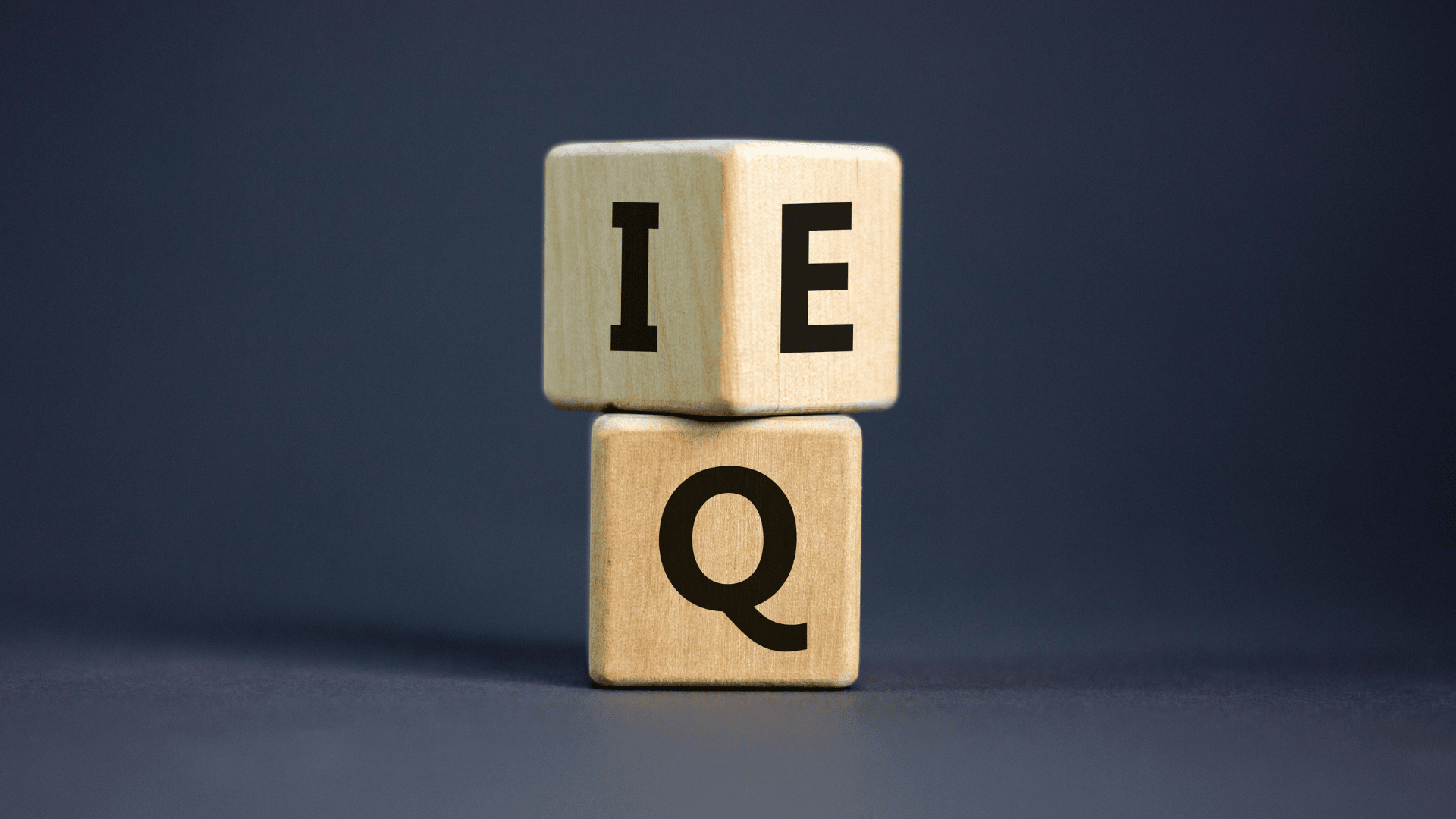
Why Your Empathy Quotient Matters More Than Your IQ in 2025
The machines are getting smarter, and for the first time in your career, you might be wondering what that means for you. Not because you doubt your abilities or track record, but because the ground beneath leadership itself is shifting. The algorithms can crunch numbers faster than your entire team combined. The AI can analyze market patterns you'd never spot. And that presentation deck you spent hours perfecting? Technology could generate it in minutes.
So what's left for you?
Everything that actually matters.
While business publications obsess over AI capabilities and technological disruption, they're missing the most important story unfolding in boardrooms and leadership teams around the world. As artificial intelligence assumes more analytical responsibilities, a profound reversal is occurring in what makes leaders valuable. The very skills that once seemed soft, secondary, or even indulgent are now becoming the hardest competitive advantages your organization can develop.
Your empathy quotient, your ability to understand and connect with the humans around you, isn't just a nice leadership quality anymore. It's becoming the primary differentiator between leaders who thrive in this new landscape and those who become as obsolete as the systems they're being compared to.
The Value Proposition of Leadership Is Being Rewritten
Consider what you were hired to do when you stepped into your first leadership role. Chances are, a significant portion of your value came from your ability to process information, identify patterns, make data-informed decisions, and execute strategy based on analysis. You could see connections others missed. You could synthesize complex information into actionable plans. Your brain was your competitive advantage.
That advantage is evaporating, and it's happening faster than most leaders want to acknowledge.
The uncomfortable truth is that AI systems are already superior at the analytical tasks that consumed much of your leadership attention. They don't get tired. They don't have cognitive biases, or at least not the same ones you do. They can process variables and scenarios at a scale that makes human analysis look quaint. And they're improving exponentially while your analytical capabilities remain relatively fixed.
But here's what the technology anxiety misses entirely: the erosion of your analytical advantage is simultaneously revealing your most powerful capabilities. The ones that were always there but seemed less important when you could also claim superiority in data processing and strategic analysis. The human capabilities that no algorithm can replicate because they exist in the unmeasurable space between people.
What Technology Cannot Tokenize: The Irreplaceable Human Core
Picture the last truly difficult decision you made as a leader. Not the kind where the data pointed clearly in one direction, but the kind that kept you up at night. The decision where spreadsheets and projections could only take you so far, and ultimately, you had to weigh competing values, consider human impact, and trust your judgment about people and culture and timing.
That's where your future value lives.
When you exercised empathy in that decision, you weren't being soft. You were accessing a sophisticated processing system that considers variables no AI can quantify. How will this decision affect team morale? What does this signal about our values? How will Sarah respond versus how Marcus will respond, given their different circumstances and perspectives? What cultural ripples will this create? What does my gut tell me about the human factors at play?
These aren't secondary considerations to be addressed after the real analysis is done. These are the analysis that matters most, and they require a form of intelligence that operates entirely differently from computational processing. They require empathy.
Empathy allows you to map the emotional and relational terrain of your organization with a precision that no sentiment analysis algorithm can approach. It lets you read the room, sense tension, identify unspoken concerns, and understand the human system you're actually leading, not just the organizational chart you're managing. And critically, empathy enables you to build the trust that transforms a group of individuals into a high-performing team.
The Three Pillars Where Empathy Creates Organizational Leverage
Your empathy quotient doesn't operate in isolation. It's the foundation that makes three essential leadership capabilities possible, each of which becomes more valuable as AI assumes more analytical functions.
Clarity: Seeing Your People and Organization as They Actually Are
Most leadership failures don't stem from bad strategy but from operating on incomplete or distorted information about the human reality of your organization. You make decisions based on what you think is happening rather than what's actually happening. You assume alignment where confusion exists. You miss early warning signs because you're not attuned to the emotional undercurrents.
Empathy is what gives you clarity about the true state of your team and organization. It's the capacity to set aside your own perspective long enough to genuinely understand someone else's experience. To see how your ambitious new initiative lands completely differently for the team that's already stretched thin versus the team that's hungry for a challenge. To recognize that the quiet person in meetings isn't disengaged but processing differently, or dealing with something outside of work that's affecting their presence.
This clarity doesn't come from employee engagement surveys or data dashboards. It comes from the deeply human practice of paying attention to people with genuine curiosity and care. It comes from asking questions and actually listening to the answers instead of waiting to speak. It comes from noticing what's not being said as much as what is.
When you lead with this kind of empathetic clarity, your decisions become dramatically more effective because they're based on accurate input about the human system you're leading. You're not shooting in the dark or operating on assumptions. You're responding to reality.
Courage: Making Human-Centered Decisions When It's Difficult
Empathy without courage is mere sympathy; it notices pain but doesn't act on it. The second pillar where empathy creates leverage is in giving you the foundation for brave, human-centered decision-making, even when those decisions come with personal or organizational cost.
Imagine you're facing pressure to implement a change that the data suggests will improve efficiency but that you sense will damage your culture in ways that matter more than the projected gains. The empathetic leader doesn't just notice this tension. They have the courage to advocate for the human factors that can't be quantified, to push back on decisions that optimize for metrics while degrading the human system, to make calls that prioritize long-term trust over short-term gains.
This is where your irreplaceable value as a human leader becomes most visible. AI can optimize for any variable you feed it, but it cannot weigh competing values. It cannot decide that protecting your team's wellbeing matters more than hitting this quarter's numbers. It cannot choose principle over expedience. It cannot exercise moral courage.
You can. And in an era where technology can handle most analytical functions, your willingness to make difficult human-centered decisions becomes your primary leadership contribution. Empathy is what allows you to see what's at stake. Courage is what allows you to act on it. Together, they make you valuable in ways that transcend any technological replacement.
Resilience: Building Connected Teams That Weather Storms Together
The third pillar where empathy creates leverage is in developing organizational resilience, the capacity of your team to navigate difficulty, adapt to change, and maintain performance under pressure. And here's what every leader eventually learns: resilience isn't individual fortitude scaled up. It's connection.
Teams become resilient not because they're made up of tough individuals, but because they're made up of connected individuals who support each other through challenges. And that connection is built through empathy. Through the daily practice of seeing each other, understanding each other, caring about each other's experience, and showing up for each other when it matters.
When you lead with empathy, you create psychological safety, the condition where people can take risks, admit mistakes, ask for help, and bring their full selves to work. You build trust, the foundation that allows teams to move quickly because they don't have to protect themselves from each other. You foster belonging, the sense that people are valued not despite their humanity but because of it.
These aren't soft benefits that make work more pleasant. They're hard competitive advantages that directly impact performance. Connected teams innovate more effectively because psychological safety enables creative risk-taking. They execute more efficiently because trust reduces friction. They retain talent more successfully because belonging creates commitment. And they weather inevitable difficulties more resiliently because people support each other rather than fragmenting under pressure.
No AI system can build this kind of connected, resilient team culture. It requires the sustained practice of human empathy, of leader after leader choosing to see their people clearly, make human-centered decisions courageously, and invest in connection consistently.

The Neuroscience Behind Why Empathy Creates Trust
Understanding why empathy works the way it does helps illuminate why it's so irreplaceable. Your brain contains specialized systems designed specifically for social connection and understanding. Mirror neurons fire when you observe someone else's experience, creating a neurological simulation of their state within your own brain. This isn't metaphorical connection. It's your nervous system literally resonating with another person's experience.
When you empathetically attune to someone, you're not just being nice. You're activating ancient neural circuitry that evolved to facilitate human cooperation and connection. Your limbic system processes emotional information and communicates it to others through micro-expressions, tone of voice, and body language that operate below conscious awareness. When someone senses genuine empathy from you, they're not making a cognitive judgment. They're receiving neural and physiological signals that you're safe, that you see them, that you can be trusted.
This is why empathy creates trust in ways that no amount of competence or consistency can replicate on their own. Trust isn't primarily a rational calculation. It's a felt sense that emerges from repeated experiences of being understood and valued. When people feel genuinely seen and understood by you, their nervous system downregulates threat responses and upregulates connection systems. They become more open, more collaborative, more willing to take risks and admit vulnerabilities.
Technology can simulate many human capabilities, but it cannot trigger these deep neurological trust responses. It cannot make someone feel truly seen. It cannot create the felt sense of safety that emerges from genuine empathetic attunement. This is your biological competitive advantage as a human leader, and it becomes more valuable as more analytical functions get automated.
The Trainable Nature of Empathy: Your Development Opportunity
If you're wondering whether you have enough natural empathy to succeed in this new leadership landscape, you're asking the wrong question. The critical insight is that empathy is a skill that can be developed, not just a trait you either have or don't.
Think about empathy as having three distinct components, each of which can be strengthened through deliberate practice. Cognitive empathy is your ability to understand another person's perspective intellectually. Emotional empathy is your capacity to feel resonance with another person's emotional state. Compassionate empathy is your inclination to act on that understanding and feeling to support or help.
Each component operates somewhat independently and can be developed through different practices. You can improve cognitive empathy by actively seeking to understand perspectives different from your own, by asking more questions and making fewer assumptions, by studying how different backgrounds and experiences shape worldviews. You can develop emotional empathy by paying closer attention to emotional information, both in others and in yourself, by practicing presence and reducing distractions when interacting with people. You can strengthen compassionate empathy by consistently acting on your understanding and care, even in small ways.
The leaders who will thrive in the years ahead aren't necessarily those who start with the highest natural empathy. They're the ones who recognize empathy as a capability worth investing in and who commit to its development with the same rigor they've applied to developing their analytical or strategic skills.
How Empathy Becomes a Force Multiplier for Performance
Perhaps you're still wondering whether focusing on empathy is a luxury, something to think about after you handle the hard business realities. This perspective has the causation backwards. Empathy isn't something you add on top of business performance. It's what makes business performance possible at a high level.
Consider how empathy affects every critical leadership function. When you're building strategy, empathy allows you to understand your customers' actual needs and pain points rather than projecting your assumptions. When you're driving change, empathy helps you address the human factors that make or break adoption. When you're developing talent, empathy enables you to see people's potential and tailor your approach to how they actually learn and grow. When you're navigating conflict, empathy allows you to understand all perspectives and find resolutions that address underlying needs rather than just surface positions.
In each case, empathy isn't separate from the hard work of leadership. It's what makes the hard work effective. It's the force multiplier that determines whether your intelligence, experience, and effort actually translate into results or get dissipated through human friction, misalignment, and resistance.
Organizations led by empathetic leaders consistently outperform in ways that compound over time. They retain talent better because people want to work there. They innovate more effectively because psychological safety enables creative risk-taking. They execute more efficiently because trust reduces coordination costs. They adapt more quickly because people are more willing to embrace change when they feel understood and valued through the transition.
These aren't peripheral benefits. In a world where AI handles most analytical heavy lifting, these human factors become the primary determinants of organizational success. Your empathy quotient becomes your competitive advantage because it's what enables you to build and lead organizations that perform at a level technology alone cannot achieve.

Your Leadership Value in an AI World
The question isn't whether AI will continue expanding its capabilities. It will. The question is what that expansion reveals about your unique value as a human leader. And the answer is becoming increasingly clear.
Your value lies not in competing with AI at analytical tasks, but in exercising the deeply human capabilities that create the conditions for human performance. Your value is in seeing people clearly and building on that understanding. Your value is in making difficult, human-centered decisions that balance competing values in ways no algorithm can. Your value is in creating connection and trust that allows teams to function as more than the sum of their parts.
These capabilities all flow from empathy. Not empathy as a soft skill or a nice-to-have, but empathy as the core competency that makes you valuable when machines can handle most everything else. Your empathy quotient, your capacity to understand and connect with the humans around you, is your competitive advantage in 2025 and beyond.
The leaders who embrace this shift, who invest in developing their empathy with the same rigor they once applied to developing their analytical skills, will find themselves more valuable and more effective than ever. Not despite technological advancement, but because of it. Because as AI assumes more analytical functions, it throws into sharp relief what only human leaders can do: see people, care about people, and make decisions that honor our humanity while driving performance.
The future of leadership isn't about competing with AI. It's about becoming more fully human in your leadership. It's about developing the capabilities that technology will never replicate. It's about building your empathy quotient with the same intentionality you once applied to building your IQ.
So here's the question to sit with: What would change in your leadership if you approached empathy development as your primary competitive advantage? What would become possible if you invested in understanding and connecting with people as rigorously as you've invested in understanding markets, strategies, and operations? What version of leadership is waiting for you on the other side of that commitment?
The machines are getting smarter. And they're revealing what actually matters. Your move.